Top 10 Reads of 2025
It is one of the great joys of my life to trade book recommendations, and it is deeply heartening that that is true for so many of you, since these annual posts are among the most read and requested!
I must say - this was a particularly hard year to narrow down to ten. There are a number of reads that could easily have ended up on the ‘Top’ list, but that is due to the strength of the bench, rather than a lack of standouts.
Longtime readers will know that my Top 10 list is by no means an effort to define the objectively ‘best’ reads from that year’s list - it’s simply what I personally found most compelling, helpful, interesting or entertaining.
I hope you find some interesting books here to add to your list!
Top 10
In no particular order…
1. Genghis Kahn and the Making of the Modern World (Jack Weatherford)
“As he smashed the feudal system of aristocratic privilege and birth, he built a new and unique system based on individual merit, loyalty, and achievement. He took the disjointed and languorous trading towns along the Silk Route and organized them into history’s largest free-trade zone.
He lowered taxes for everyone, and abolished them altogether for doctors, teachers, priests, and educational institutions. He established a regular census and created the first international postal system. His was not an empire that hoarded wealth and treasure; instead, he widely distributed the goods acquired in combat so that they could make their way back into commercial circulation.
He created an international law and recognized the ultimate supreme law of the Eternal Blue Sky over all people. At a time when most rulers considered themselves to be above the law, Genghis Khan insisted on laws holding rulers as equally accountable as the lowest herder. He granted religious freedom within his realms, though he demanded total loyalty from conquered subjects of all religions. He insisted on the rule of law and abolished torture, but he mounted major campaigns to seek out and kill raiding bandits and terrorist assassins.”
2. Stillness is the Key (Ryan Holiday)
“This is, in fact, the first obligation of a leader and a decision maker. Our job is not to “go with our gut” or fixate on the first impression we form about an issue. No, we need to be strong enough to resist thinking that is too neat, too plausible, and therefore almost always wrong. Because if the leader can’t take the time to develop a clear sense of the bigger picture, who will? If the leader isn’t thinking through all the way to the end, who is?”
3. Tightrope (Nicholas D. Kristof, Sheryl WuDunn)
“We proudly assert, ‘We’re number 1!’ and in terms of overall economic and military strength, we are. But in other respects our self-confidence is delusional.
Here’s the blunt, harsh truth.
America ranks number 40 in child mortality, according to the Social Progress Index, which is based on research by three Nobel Prize-winning economists and covers 146 countries for which there is reliable data. We rank number 32 in internet access, number 39 in access to clean drinking water, number 50 in personal safety and number 61 in high-school enrolment… Overall, the Social Progress Index ranks the United States number 25 in well-being of citizens, behind all the other members of G7 as well as significantly poorer countries like Portugal and Slovenia…
The first lesson of our journey and theme of this book is that to a degree unnoticed in more privileged parts of America, working-class communities have collapsed into a miasma of unemployment, broken families, drugs, obesity and early death. America created the first truly middle class society in the world, but now a large share of Americans feel themselves at risk of tumbling out of that security and comfort. There’s a brittleness to life for about 150 million Americans, with a constant risk that sickness, layoffs or a car accident will cause everything to collapse. One in seven Americans lives below the poverty line, a substantially higher rate than in Canada or other OECD countries, and scholars estimate that half of all Americans will at some point slip below the line…
The second theme of this book is that suffering in working-class America was not inevitable but rather reflects decades of social policy mistakes…
The third theme we pursue is more hopeful: the challenges are not insurmountable, and we can adopt policies that are both compassionate and effective. While there are no magic wands, we will outline policies that can mitigate suffering and provide traction for struggling families. Early childhood programs for at-risk kids pay for themselves seven times over in reduced spending on juvenile detention, special education and policing, according to Nobel Prize-winning economist James Heckman.”
4. Learning to Dance in the Darkness (Stewart Bogle)
“We’d expected Heather to have a second procedure on the Monday, and to be heading home feeling a million dollars after having nearly two and a half litres drained from her lung. Instead, I sat next to her as she slept, listening to the sound of laboured breathing and the sight of her attached tubes reminding me that she wasn’t coming home today. I wondered when she’d come home. She wondered whether she’d ever come home.
Luke continued to battle so rather than leave him once again with the grandparents, I brought him in to be with his mum in hospital a couple of times. While it was anything but exciting, he seemed to have a great time with his pillars of strength close by. At one point, the surgeon that we’d been waiting on for so long came in and announced he was going to do the procedure there and then in the room. I was completely thrown by this, as there’d been no warning, and he wanted to do it on the spot.
There was no time to send Luke elsewhere, so I organised for the curtain to be pulled across and sat Luke on one side playing cards, with my legs either side of the curtain so I could also hold Heather’s hand. Luke would call ‘Fish’ as the surgeon worked, while I tried simultaneously to smile for my little boy and show my love and concern for my wife. This was a metaphor of life for me—sitting in the middle, trying to be there for those I loved.”
5. Looked After (Ashley John-Baptiste)
“‘Ashley, you should know by now that when you reach the age of eighteen you leave foster care, which means you’ll leave this home and will likely move into a council flat.’ Helena was very matter-of-fact. This clearly wasn’t her first time breaking news like this to foster kids.
This lecture came during my first proper review meeting since I’d moved in with the Bennetts. Evelyn and Clinton hosted the usual group of review professionals in their guest living room.
The reviewing officer spoke after Helena. ‘Now that you’re fifteen, we need to start preparing you for the realities of leaving care. You’ll need to be able to cook for yourself, handle money and bills, maintain your accommodation . . .’
The reviewing officer’s speech was anxiety-inducing for me. The prospect of leaving care wasn’t something I really thought about. The pressure of survival dominated everything. In many ways, I still felt like the little boy being let go by Joyce. I was still drifting. Still looking for love. Still trying to make sense of this brutal system.
There was no way I’d be able to live alone in three years, I thought to myself. I looked across the room – at the social workers, the reviewing officer and at Evelyn and Clinton. A sober look was plastered on each of their faces. I could see from their expressions that I had some growing up to do.”
6. She Deserves Better (Sheila Wray Gregoire, Rebecca Gregoire Lindenbach, Joanna Sawatsky)
“My (Sheila’s) husband is a pediatrician. Before suggesting a new asthma treatment for a patient, he scours research. He wants to know what has been shown to actually work. He could just offer a regimen that “feels” right to him or that he could justify why it “should” work, but that would be irresponsible: nothing beats cold, hard numbers.
We don’t actually have many evidence-based protocols for raising daughters in the church. Sure, we have a lot of theology, opinions, and cultural norms—but what’s been missing is actual evidence of whether our methods work…
That’s what we’re hoping to do with our research. After we surveyed 20,000 women and 3,000 men, we then set out to survey another 7,500 women specifically on their experiences and beliefs as teens. That survey of teenage experiences and the focus groups that went along with it form the backbone of this book and the majority of the charts in it, supplemented by results from our original 20,000-woman survey. We looked at how key parenting practices, experiences at church, and evangelical teachings in general affect girls’ self-esteem, relationship choices, future marriages, and more. And we’ve got to level with you: a lot of what the church has been teaching our teenage girls has some really, really bad fruit.”
7. The AI-Driven Leader (Geoff Woods)
“The issue was that the agents came up with initial ideas and asked AI to make them better. This was not the goal. The goal was to come up with the most creative ideas to optimize interactions and boost customer service. But the way the agents communicated with AI caused it to stay within the boundaries of enhancing the existing ideas rather than getting outside the box and generating the most creative solutions. Instead of challenging their biases, AI amplified them.”
8. Awake (Jen Hatmaker)
“At 2:30 a.m. on July 11, 2020, out of a dead sleep, I hear five whispered words not meant for me: “I just can’t quit you.” My husband of twenty-six years is voice-texting his girlfriend next to me in our bed.
It is the end of my life as I know it.
The next four hours are chaos. While he eventually passes out from a treacherous combination of booze and exposure, I follow a trail of betrayal on his computer, an entire other life. My body is frozen. I can’t even cry. My whole world is slipping away click by click. I float above myself watching my brain absorb the impossible, watching my heart splinter. So this is what it looks like when a life unravels in real time. It is quieter than I expected.
The kids are upstairs asleep, unaware that their story has just split in half. They went to bed in the hazy, lazy days of summer polluted by a four-month-old COVID outbreak but otherwise sleeping the comfortable sleep of kids whose parents will always be just downstairs; family disruption might come from outside but never from within. Not ours anyway. I keep thinking: ‘They don’t know. I don’t want to know. I want to go upstairs with them and not know.’”
9. Spin Dictators (Sergei Guriev, Daniel Treisman)
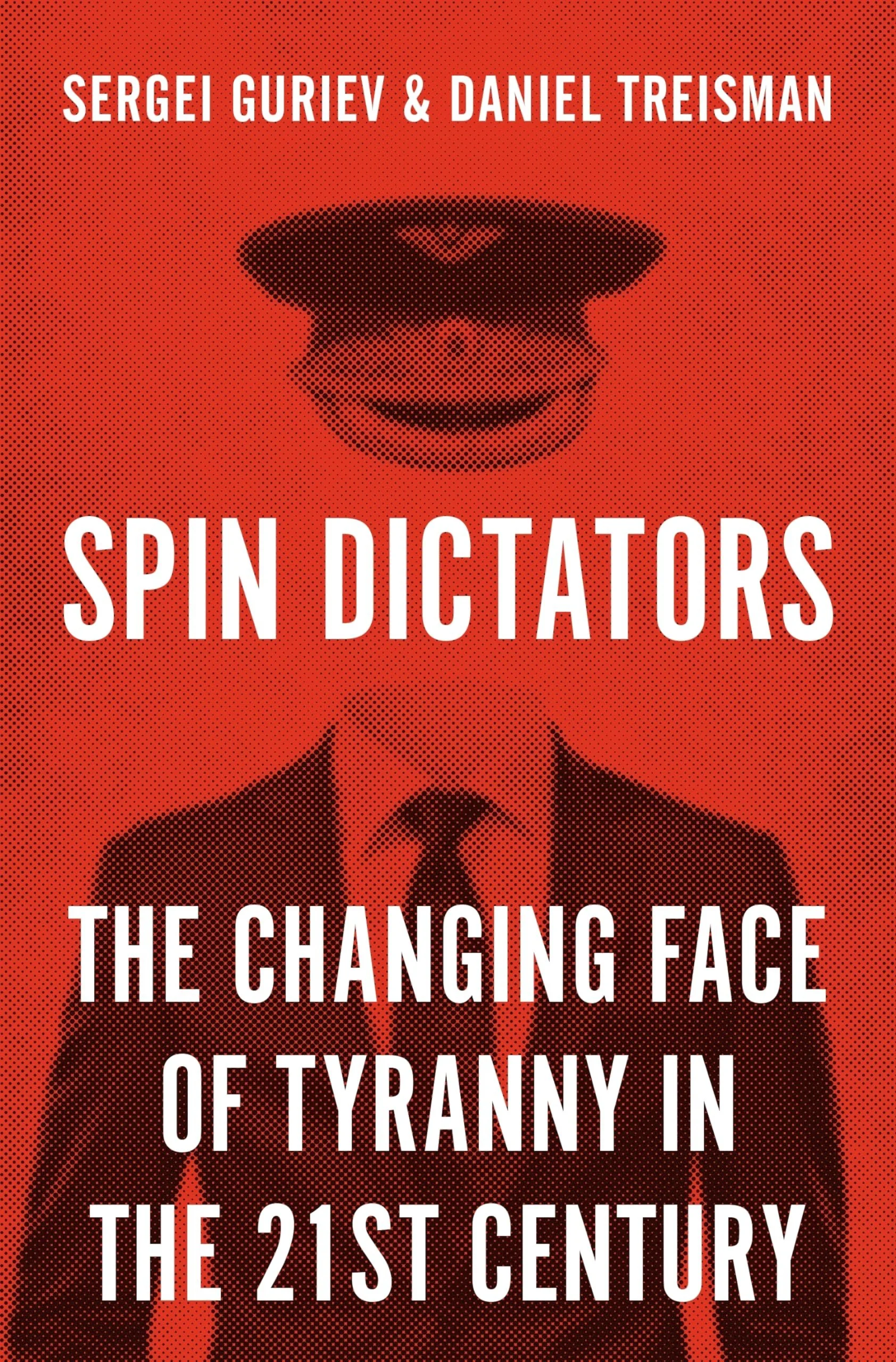
“These four changes—in the nature of work, education, social values, and communication technology—make it harder for dictators to dominate citizens in the old way. Harsh laws and bureaucratic regulations provoke furious responses from previously docile groups. These groups have new skills and networks that help them resist.
At the same time, violent repression and comprehensive censorship destroy the innovation now central to progress. Eventually, the expansion of the highly educated, creative class, with its demands for self-expression and participation, makes it difficult to resist a move to some form of democracy. But so long as this class is not too large and the leader has the resources to co-opt or censor its members, an alternative is spin dictatorship. At least for a while, the ruler can buy off the informed with government contracts and privileges…
Early in the postindustrial era, most people still have industrial-era values. They are conformist and risk averse. The less educated are alienated from the creative types by resentment, economic anxiety, and attachment to tradition. Spin dictators can exploit these sentiments, rallying the remaining workers against the “counterculture” while branding the intellectuals as disloyal, sacrilegious, or sexually deviant. Such smears inoculate the leader’s base against opposition revelations.
As long as the informed are not too strong, manipulation works well. Dictators can resist political demands without destroying the creative economy or revealing their own brutality to the public.”
10. Influencer (Joseph Grenny, Kerry Patterson, David Maxfield, Ron McMillan, Al Switzer)
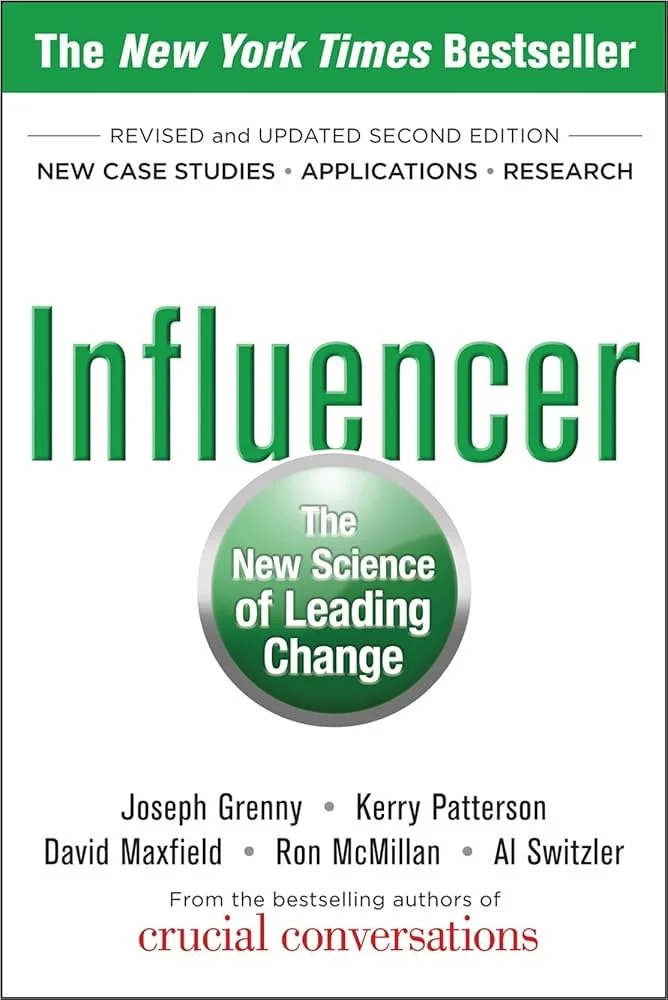
“Instead, they count on three keys to success—keys that all influencers adhere to and that you can use to your own benefit:
1. Focus and measure. Influencers are crystal clear about the result they are trying to achieve and are zealous about measuring it.
2. Find vital behaviors. Influencers focus on high-leverage behaviors that drive results. More specifically, they focus on the two or three vital actions that produce the greatest amount of change.
3. Engage all six sources of influence.
Finally, influencers break from the pack by overdetermining change. Where most of us apply a favorite influence tool or two to our important challenges, influencers identify all of the varied forces that are shaping the behavior they want to change and then get them working for rather than against them. And now for the really good news. According to our research, by getting six different sources of influence to work in their favor, influencers increase their odds of success tenfold.”
And the rest of the full list -
11. Reconnected: How 7 Screen-Free Weeks with Monks and Amish Farmers Helped Me Recover the Lost Art of Being Human (Carlos Whittaker)
12. Mind Your Mindset (Michael Hyatt, Megan Hyatt Miller)
13. Tomorrow, When the War Began (John Marsden) [re-read]
14. Remote Not Distant (Gustavo Razzetti)
15. All It Takes is a Goal (Jon Acuff)
16. The Economic Weapon: The Rise of Sanctions as a Tool of Modern War (Nicholas Mulder)
17. The Woman They Wanted (Shannon Harris)
18. Mary Jane (Amy Hertzog)
19. Lasting Impact (Carey Nieuwhof)
20. Man-Made: How the Bias of the Past is Being Built into the Future (Tracey Spicer)
21. From Strength to Strength (Arthur C. Brooks)
22. Negotiation Made Simple (John Lowry)
23. Things Will Calm Down Soon (Zoë Foster Blake)
24. How to Be a Great Manager (Rachel Pacheco)
25. The Mysterious Affair at Styles (Agatha Christie)
26. Ten Signs of a Leadership Crash (Stephen Mansfield)
27. The Turn of the Screw (Henry James)
28. How AI Will Change Your Life (Patrick Dixon)
29. Think Bigger (Sheena Iyengar)
30. Odour of Chrysanthemums (D.H. Lawrence)
31. Paging Dr. Gupta (Dr. Sanjay Gupta)
32. Feck Perfuction (James Victore)
33. A Streetcar Named Desire (Tennessee Williams)
34. The Let Them Theory (Mel Robbins)
35. The Good Life (Jeremy Hall)
36. A New Way to Think (Roger L. Martin)
37. Co-Intelligence: Living and Working with AI (Ethan Mollick)
38. Heart of Darkness (Joseph Conrad) [re-read]
39. The 16 Undeniable Laws of Communication (John Maxwell)
40. Successful Women Speak Differently (Valerie Burton)
41. Jurassic Park (Michael Crichton) [re-read]
42. Surrounded by Idiots: The Four Types of Human Behaviour and How to Effectively Communicate with Each in Business (and in Life) (Thomas Erikson)
43. Duel Transformation: How to Reposition Today’s Business While Creating the Future (Scott D. Anthony, Clark G. Gilbert, Mark W. Johnson)
44. Turning 15 on the Road to Freedom: My Story of the 1965 Selma Voting Rights March (Lynda Blackman Lowery, Elspeth Leacock, Susan Buckley)
45. The Last Conversation (Paul Tremblay)
46. Homage to Catalonia (George Orwell)
47. Anthem (Ayn Rand)
48. The First 90 Days (Michael D. Watkins) [re-read]
49. Getting Along (Amy Gallo)
50. Leading with Heart: Five Conversations That Unlock Creativity, Purpose, and Results (John Baird, Edward Sullivan)
51. All My Knotted-Up Life (Beth Moore)
52. The Secret History of Christmas (Bill Bryson)
53. 107 Days (Kamala Harris)